
GHK-Cu and lysyl oxidase: why collagen needs copper
Lysyl oxidase cross-links collagen and elastin, and it needs copper to do so. That biochemistry is the context for one hypothesis about why GHK-Cu appears so often in collagen research.
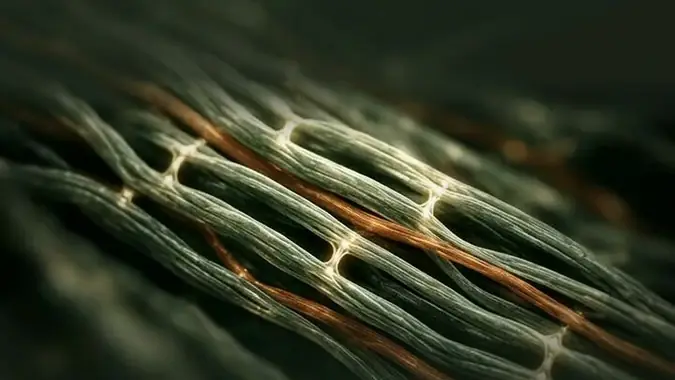
Collagen cannot hold its shape without copper, and the reason is an enzyme that rarely gets attention. Lysyl oxidase links the fibers together, and it depends on copper to do it. This article sets out that biochemistry and the hypothesis that connects it to GHK-Cu research.
What lysyl oxidase does
Lysyl oxidase cross-links collagen and elastin fibers. This step turns loose strands into a stable, load-bearing matrix. The enzyme is copper-dependent: without bioavailable copper, there is no cross-linking.
Two pieces of supporting biochemistry
Two other facts sit alongside the copper requirement.
- Vitamin C is a required cofactor for the enzymes that stabilize collagen before cross-linking. This is why scurvy breaks down connective tissue.
- Zinc and copper compete for absorption, and long-term excess zinc is a documented cause of copper deficiency.
Both show how many upstream conditions collagen stability depends on. Copper availability is one of them.
Where GHK-Cu fits
GHK is a tripeptide with an unusually high affinity for copper. One hypothesis in the literature is that part of the activity of GHK-Cu comes from carrying copper to tissue where copper-dependent repair enzymes, lysyl oxidase among them, operate.
That would help explain why this peptide keeps appearing in collagen research when most peptides do not. The connection is plausible, because it links a copper-binding peptide to a copper-dependent enzyme in matrix biology.
Limits of the evidence
This is a hypothesis, not a settled mechanism. A copper-carrier model predicts that copper delivery, and not only the peptide itself, accounts for part of the observed activity. Testing that prediction requires experiments that separate the peptide's own signaling from copper delivery. Until that work is clear in the literature, the link between GHK-Cu and lysyl oxidase should be read as a framework for designing experiments, not as a conclusion.