
GHK-Cu vs retinol: two routes to collagen synthesis research
Retinoids and the copper tripeptide GHK-Cu are both studied for collagen synthesis, but they reach it through very different upstream mechanisms.
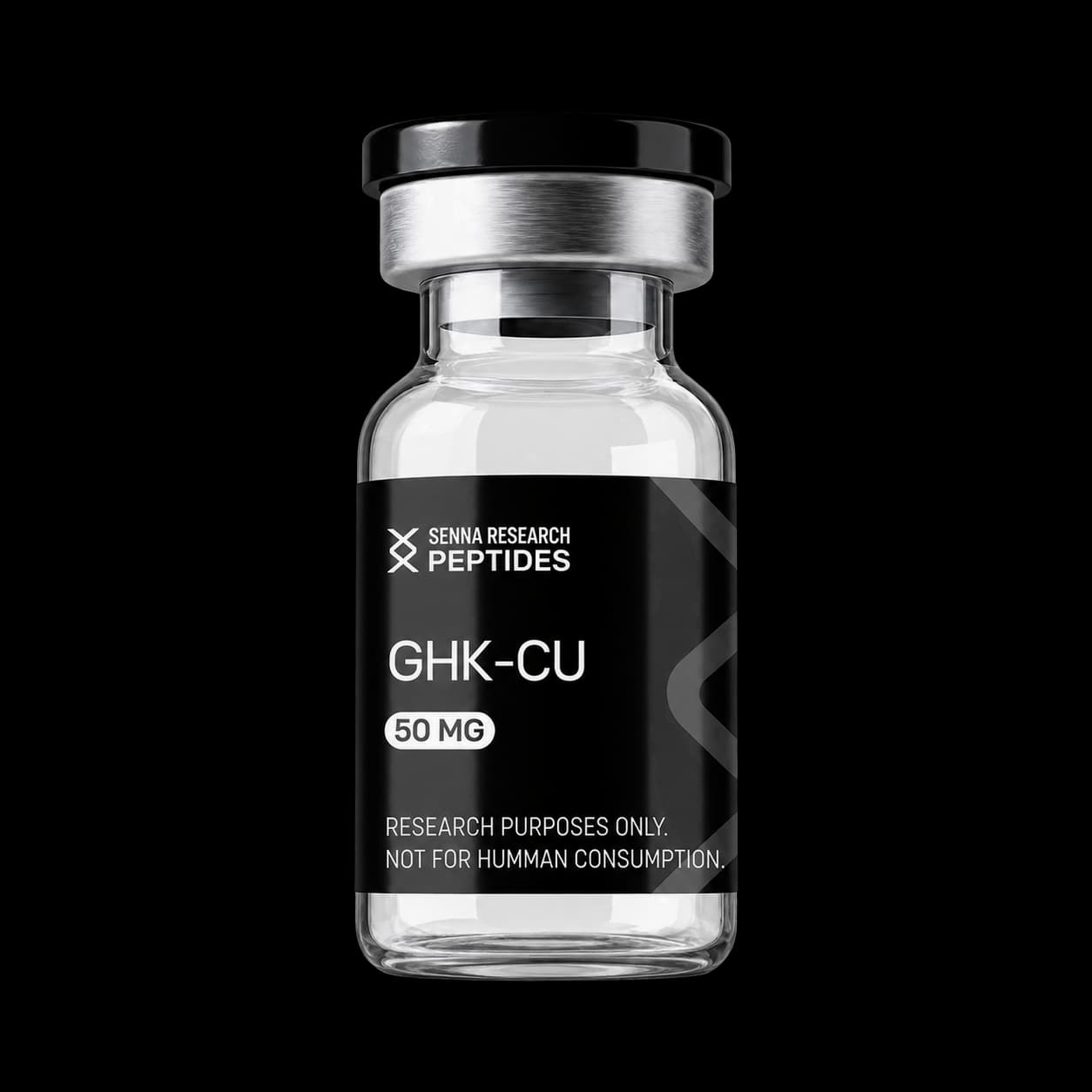
Retinol has been the reference collagen stimulator in skin biology for more than 40 years. Its proposed mechanism depends on accelerated cell turnover driven by controlled micro-injury and localized inflammation. GHK-Cu, the copper-binding tripeptide also called copper tripeptide-1, is studied as a different route to the same downstream interest: collagen synthesis and tissue remodeling reached through signaling rather than irritation.
How retinoids are thought to drive collagen turnover
Retinoids, the vitamin A family that includes retinol and tretinoin, are associated with faster cellular turnover. The model is one of controlled damage: micro-injury and localized inflammation prompt the tissue to renew itself. In the retinoid literature this is commonly accompanied by peeling, redness, photosensitivity and a temporary loss of barrier integrity before structural changes appear.
Retinoid research has centered largely on collagen I stimulation.
GHK-Cu as a signal rather than an irritant
GHK-Cu is a naturally occurring tripeptide (glycine, histidine, lysine) that binds copper. Rather than acting through structural damage, it is studied as a biological signal: a short sequence that cells read as an instruction to increase extracellular matrix production and to upregulate repair-associated genes.
Gene expression
Studies report that GHK-Cu modulates the expression of more than 4,000 genes in tissue models, shifting markers associated with damaged tissue toward a repair-associated profile.
Collagen I, III and elastin
Where retinoid work focuses on collagen I, GHK-Cu research reports activity across collagen I, collagen III and elastin synthesis, three of the main structural components of the dermal matrix.
Barrier and inflammation markers
In study models, GHK-Cu research describes barrier-supportive and anti-inflammatory activity, in contrast to the irritation profile associated with retinoids.
Same downstream target, different upstream mechanism
The useful distinction for researchers is upstream. A retinoid reaches matrix renewal by provoking a damage response. A signal peptide such as GHK-Cu is studied for reaching collagen and elastin synthesis directly, by changing what cells are told to make. One route removes structure so it can be rebuilt; the other changes the instructions given to the cells that build it.
Where the evidence stands
Copper peptide research is an active and evolving field, and much of it comes from tissue and cell models rather than controlled comparisons against retinoids. The comparison here is mechanistic: it describes how two compound classes are thought to reach the same endpoint, not an established ranking between them. GHK-Cu remains a laboratory research target.