
Growth hormone decline after 35: CJC-1295 and Ipamorelin research
Growth hormone release declines on a measurable schedule through adulthood. Two peptides studied together, CJC-1295 and Ipamorelin, act on separate receptors that drive it.
Growth hormone does not fade quietly. Its release peaks in the teenage years and then follows a well-documented decline through adulthood, a process called somatopause. That predictable decline is why two peptides acting on separate receptors, CJC-1295 and Ipamorelin, are often studied together.
The decline, decade by decade
Estimates put the drop in growth hormone secretion at roughly 14% per decade after age 35. The pattern is usually described in three stages.
- 20s to early 30s: growth hormone pulses stay near peak adult levels.
- Mid-30s onward: the decline begins in earnest, at about 14% per decade.
- 40s and 50s: somatopause effects become more measurable, including reduced lean mass, increased visceral fat, slower recovery and changes in bone density.
Two receptors, two pathways
Growth hormone release from the pituitary is driven by more than one signal. The two peptides here each target a different one.
CJC-1295: the GHRH receptor pathway
CJC-1295 acts on the growth hormone-releasing hormone (GHRH) receptor, signaling the pituitary to release more growth hormone. The DAC form stays active for an estimated 6 to 8 days before clearing. A 2006 Phase 1 trial by Teichman and colleagues in healthy adult men measured sustained stimulation of growth hormone and IGF-1 secretion. A related Phase 2 program was later discontinued after a trial participant died; the death was determined to be unrelated to the study drug.
Ipamorelin: the ghrelin receptor pathway
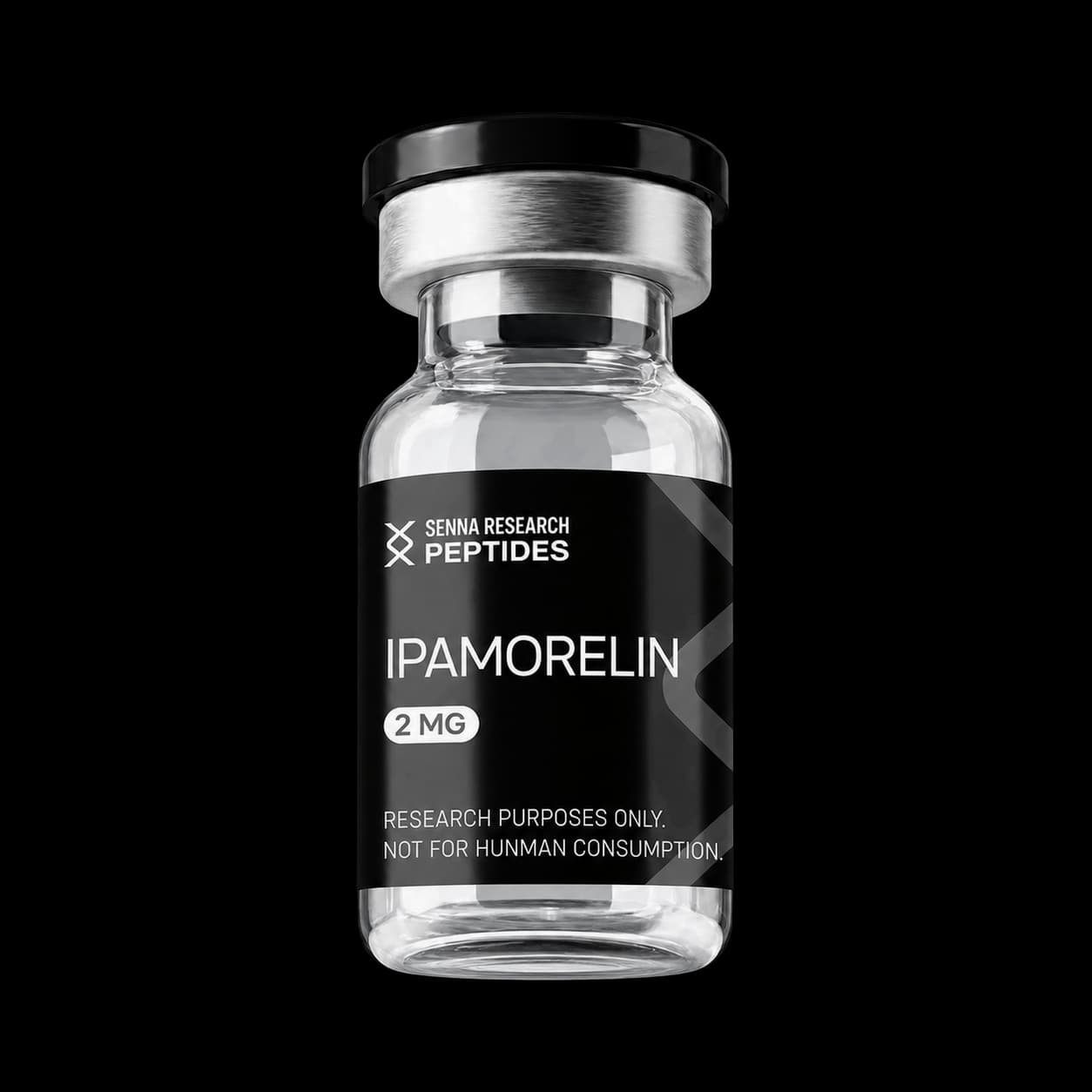
Ipamorelin acts on the ghrelin receptor, a separate route to growth hormone release. Raun and colleagues described it in 1998 in the European Journal of Endocrinology as the first selective growth hormone secretagogue. Its selectivity is the main research interest: it has been studied for minimal effects on cortisol, prolactin and appetite.
What the two share
Both peptides are mechanistically distinct from exogenous growth hormone. Rather than supplying the hormone directly, they act upstream, which preserves the natural pulsatile pattern of release and the negative feedback loop that regulates it. Those two features are the reason they are studied as a pair rather than as substitutes for growth hormone itself.
Where the evidence is thin
Long-term outcome data in aging populations is limited. The foundational 2006 Phase 1 trial enrolled healthy men aged 21 to 61, not a cohort selected for age. Long-term safety questions remain open, with cardiovascular effects, glucose regulation and cancer risk all still active areas of investigation.