01
Telomere Biology
Investigated in cell-culture models of telomere maintenance and replicative ageing.
For research use only — not for human consumption
Tissue & Repair Research
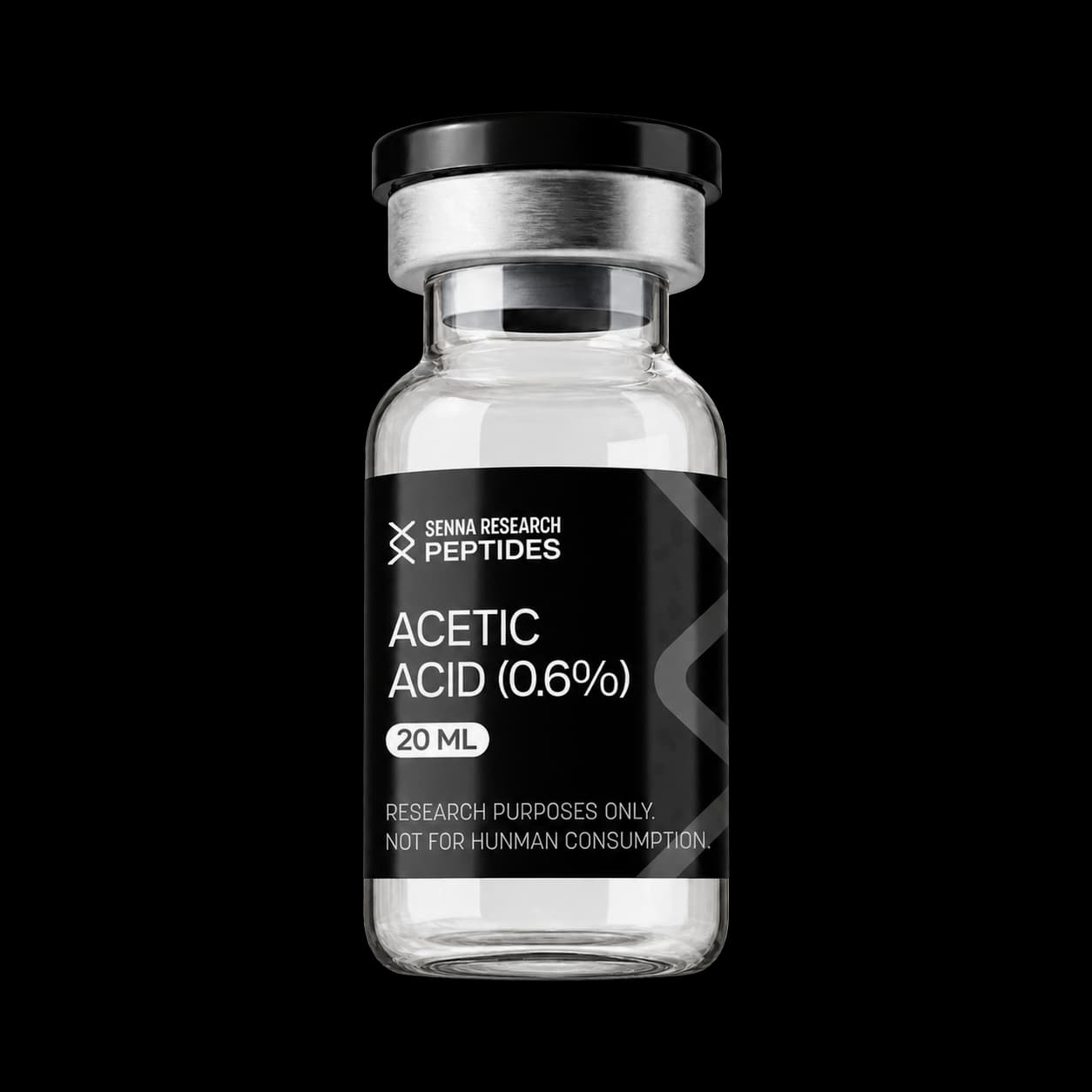
In stockAcetic Acid (0.6%) is widely referenced in peptide formulation and biochemical workflows as a mild acidic solvent. It is commonly evaluated for its influence on solubility behavior, charge state, and short-term solution stability under controlled experimental conditions [1] .
Professional pricing
Sign in or create a research account to see prices and add this material to your order. Access unlocks as soon as you create your account.
Sign in for pricingSpecifications
Lot & handling
Molecular
Analytics
When a lot certificate is on file we report identity, purity, and appearance. We publish analytical data only — never dosing information or outcome claims.
01
Chromatographic purity against a qualified reference standard.
02
Identity by observed versus theoretical molecular mass.
03
Residual moisture in lyophilized material.
04
Contaminant screening on raw material and finished lots.
Research background
Summary of the published literature this reference material is used in.
01
Investigated in cell-culture models of telomere maintenance and replicative ageing.
02
Studied for reported effects on transcriptional regulation in experimental systems.
03
Referenced in literature examining cellular senescence markers in vitro.
Low-concentration acetic acid solutions are frequently examined to address solubility challenges associated with hydrophobic or aggregation-prone sequences. Acidic environments can alter peptide ionization states, which may reduce intermolecular attractions linked to precipitation [1,2]. Researchers often compare dilute acetic acid with neutral aqueous systems to evaluate differences in dissolution efficiency, clarity, and repeatability. These observations support formulation screening and help characterize solvent-dependent behavior across different peptide classes and molecular weights.
Acetic acid is a small, well-characterized carboxylic acid with predictable behavior in aqueous systems. At low concentrations, it offers consistent pH control and remains broadly compatible with common experimental workflows [1]. Its volatility and water miscibility support controlled handling and reproducibility across standard lab procedures. These properties are extensively documented in analytical and biochemical literature, making acetic acid a common benchmark solvent component in method development.
Beyond peptide dissolution studies, acetic acid is referenced in chromatography, buffer preparation, and protein analysis workflows [2]. Its established chemical profile allows researchers to isolate solvent effects from peptide-specific variables, enabling cleaner comparisons during stability checks, solubility screening, and method optimization.
Key Specs
Referenced Citations
Mandatory research disclaimer
All materials on this site are sold as laboratory reagents for research use only. They are not drugs, foods, cosmetics, dietary supplements, or medical devices, and are not for human or veterinary use of any kind.
Senna Research makes no claims of safety or efficacy and provides no usage, dosing, or preparation guidance; we publish analytical data only.
These materials have not been evaluated or approved by the U.S. Food and Drug Administration for any use.